Aave lets you borrow against eligible collateral and repay the resulting debt
Updated on
Aave requires eligible collateral before you can take a loan against your own supplied assets. Your first borrow involves checking collateral status, choosing an available borrowing amount, and authorizing the transaction. After confirmation, inspect the borrowed tokens, outstanding debt, and health factor. Closing the loan requires repayment of the outstanding balance, including accrued interest.
Start with the wallet and market that will hold the position. A supply balance alone does not establish borrowing eligibility, and the maximum available amount leaves a different margin for price changes than a smaller loan.
Collateral that the selected market can use
The selected market must recognize your supplied asset as eligible collateral before that balance can support a loan against your own account. Tokens sitting in your wallet do not count as supplied collateral. Check the connected account, selected network, market, and collateral status before entering a borrowing amount.
Supplying and enabling collateral are separate account conditions. An asset may appear in your supplies while contributing no borrowing capacity because collateral use is disabled or unavailable. Where the market permits collateral use, enabling it requires the corresponding account change. A larger supply of an ineligible asset does not resolve that restriction.
The borrowing asset must also be available under the account's configuration. Available liquidity, borrowing caps, and restrictions on permitted collateral combinations can limit the action. A positive collateral balance therefore does not mean that every listed token is borrowable. If the selected asset remains unavailable, resolve the displayed restriction before signing.
A borrowing amount with room for change
A smaller loan leaves more unused borrowing capacity and, with other inputs unchanged, a higher health factor than a larger loan against identical collateral. The amount selector shows what the account can request under the applicable conditions. It does not establish an amount that will remain manageable through later price or interest changes.
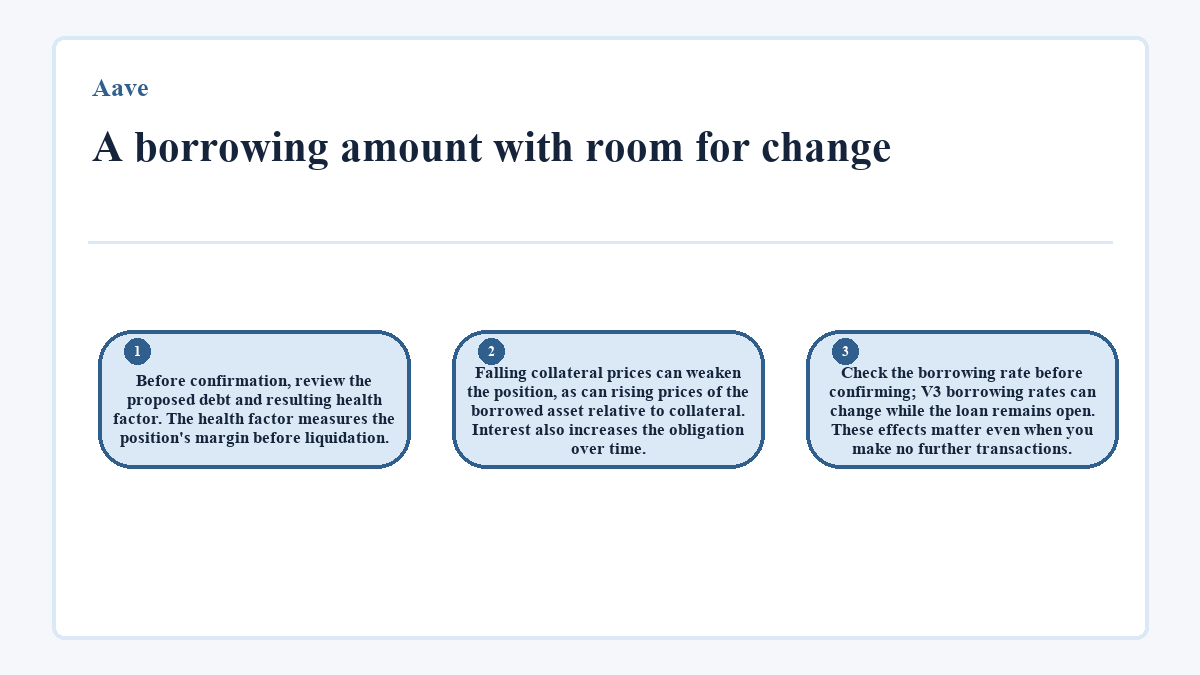
Before confirmation, review the proposed debt and resulting health factor. The health factor measures the position's margin before liquidation. Falling collateral prices can weaken the position, as can rising prices of the borrowed asset relative to collateral. Interest also increases the obligation over time. Check the borrowing rate before confirming; V3 borrowing rates can change while the loan remains open. These effects matter even when you make no further transactions.
Check how repayment tokens would reach the same market before opening the loan. Spending or transferring the borrowed balance leaves the debt outstanding. Keeping enough funds for the later transaction fees also matters: collateral locked in the position is not automatically available to pay those fees.
Permissions before the loan transaction
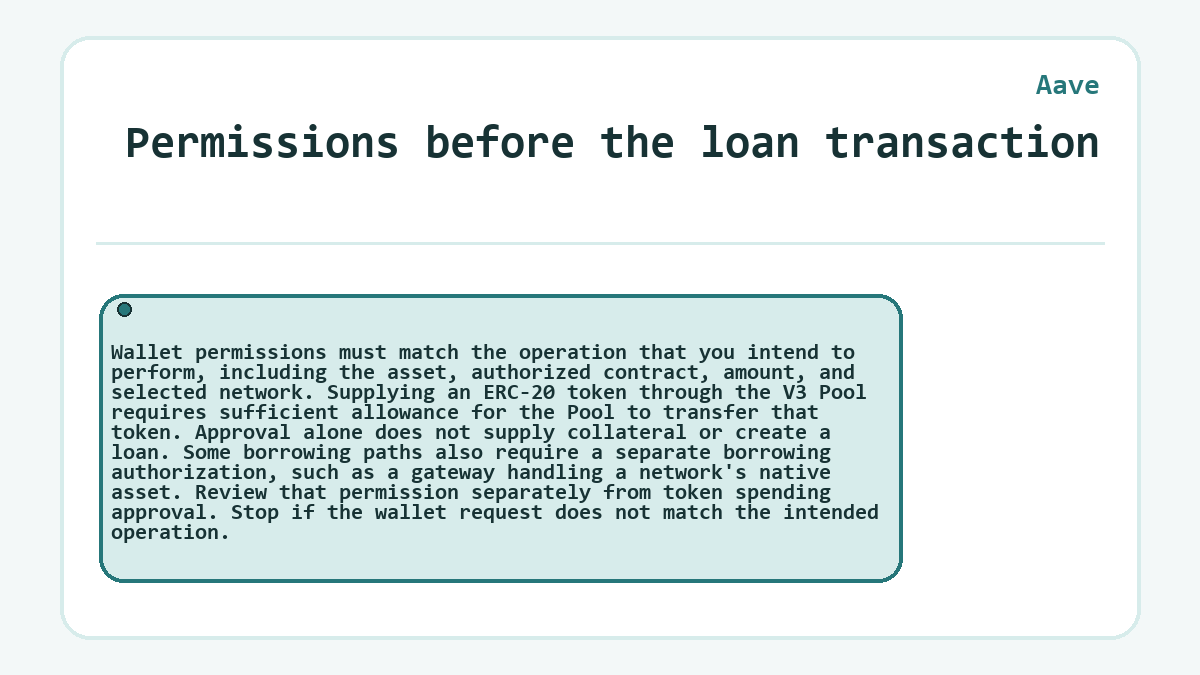
Wallet permissions must match the operation that you intend to perform, including the asset, authorized contract, amount, and selected network. Supplying an ERC-20 token through the V3 Pool requires sufficient allowance for the Pool to transfer that token. Approval alone does not supply collateral or create a loan. Some borrowing paths also require a separate borrowing authorization, such as a gateway handling a network's native asset. Review that permission separately from token spending approval. Stop if the wallet request does not match the intended operation.
How can I tell whether my first borrow succeeded?
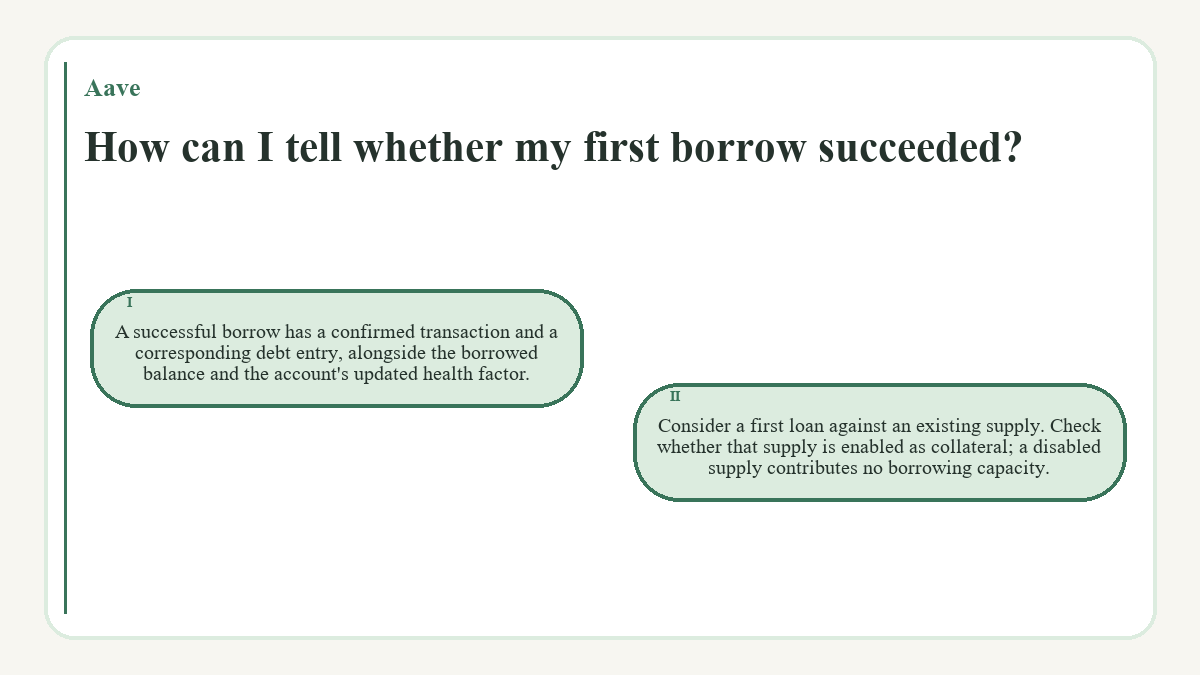
A successful borrow has a confirmed transaction and a corresponding debt entry, alongside the borrowed balance and the account's updated health factor. Consider a first loan against an existing supply. Check whether that supply is enabled as collateral; a disabled supply contributes no borrowing capacity.
Before submitting that loan, use these conditions to decide whether to proceed:
- The connected account has an eligible supplied asset enabled as collateral in the selected market.
- The requested asset and amount fit the account's available borrowing capacity and market restrictions.
- The preview shows the resulting debt and health factor for that amount.
- The wallet authorization matches the intended contract, operation, and amount.
- The wallet can pay the transaction fee, and repayment tokens can reach this market.
With those conditions satisfied, submit the chosen borrow and wait for confirmation. Compare the expected token receipt and new debt with the account record. The debt balance may already include accrued interest when you inspect it. Review the resulting health factor before making another withdrawal or borrowing decision.
If collateral use is disabled, stop before the borrow. Enable it only if the asset and account configuration permit that change, then reassess the available amount. Enabling collateral can make borrowing possible, while borrowing against it exposes that collateral to liquidation risk. If the transaction status remains unresolved, establish whether it succeeded before submitting another loan request.
Loan-to-value and the health factor
Loan-to-value limits the opening borrowing amount, while the liquidation threshold determines how much collateral value supports debt in the health calculation. These parameters serve different purposes. Read the values that apply to the selected collateral and account configuration rather than treating either percentage as universal.
In V3, the health factor equals total collateral value multiplied by its weighted average liquidation threshold, divided by total debt value. A value below 1 makes the position eligible for liquidation. After borrowing, compare the actual position with the preview and monitor it as prices and debt change. A value above 1 does not guarantee that the position will stay above that threshold.
Repayment and the remaining supply balance
Repayment reduces the loan balance, while withdrawing collateral is a separate operation that returns supplied assets to your wallet when the market permits it. For a straightforward repayment, select the debt asset and amount. If an ERC-20 spending approval is required, authorize the intended contract before submitting the repayment transaction.
Use the outstanding balance when planning a full repayment. Returning only the amount originally borrowed can leave interest unpaid. Partial repayment reduces the obligation, while the remaining debt continues to accrue interest. Check the account record after confirmation rather than relying on the amount typed into the transaction form.
A full repayment should leave no outstanding balance for that loan. Other borrowings, if present, still count against the account's collateral. A remaining supply balance represents assets still in the protocol; repayment does not automatically transfer them back to the wallet.
Withdrawal of supplied assets requires sufficient unborrowed liquidity in the selected reserve. Remaining debt can also constrain how much collateral you can remove. For a complete exit, confirm that the intended debt is cleared and that any requested withdrawal has returned the assets. If withdrawal is unavailable, the loan can be repaid while the supply position remains open.
Useful questions about Aave
-
Can I repay my first loan with a different token?
- A direct repayment uses the asset in which the debt is denominated. Another token with the same displayed value does not automatically settle that obligation. If you need to exchange tokens first, account for the amount received and the transaction costs. The repayment must cover the outstanding debt amount to close the loan fully.
-
Does transferring the borrowed money to another wallet move the debt too?
- Transferring borrowed tokens does not transfer the loan obligation to the recipient. In V3, non-transferable debt tokens record the borrowing account's outstanding obligation. Your collateral continues to support that debt after the borrowed funds leave your wallet. The recipient's possession of the tokens does not make their account responsible for repayment.
-
Will interest earned on my supplied collateral automatically repay the loan?
- Supply interest does not automatically perform a repayment of your borrowing balance. The protocol accounts for supplied assets and debt separately. A growing eligible collateral balance can affect account health, while borrowing interest increases the obligation. Closing the loan still requires a supported repayment operation that reduces the recorded debt to zero.
-
Do I pay a network fee just to sign a token permit?
- An off-chain permit signature does not itself incur a network transaction fee. Where the token and interface support permits, that signature can authorize spending without a separate approval transaction. The supply or repayment transaction that uses the permission still requires execution on the network. A signature also grants permission, so its spender and amount require review.
-
Is sending tokens directly to the pool address enough to repay?
- A plain token transfer to the pool address does not execute the repayment operation that reduces your recorded debt. Use the supported repayment transaction, which identifies the debt asset and borrowing account. Tokens leaving your wallet are not evidence that the loan has closed; the account's outstanding debt must decrease through the repayment operation.